

Shoppers who already understand the basics of portable power stations tend to ask sharper questions. How much can a unit actually run at once? How far can it scale before another box has to be purchased? This piece looks at the technical distinctions that separate Bluetti‘s home battery backup systems from one another, focusing on capacity, output, solar charging, and expansion limits rather than marketing language.
Understanding Wattage Output vs. Capacity in Bluetti Systems
Output wattage and capacity measure two different things, and mixing them up leads to the wrong purchase. Output wattage, measured in watts, is how much power a unit can deliver to connected devices at one moment. Capacity, measured in watt-hours, is how long that power can be sustained before the battery runs dry. A system with high output but modest capacity can start a large appliance but may not run it for long, while a high-capacity unit with lower output might stall on demanding tools.
Across the Bluetti range these two numbers vary independently. The Apex 300 base unit, for example, lists 3,840W of output paired with 2,764.8Wh of capacity, while the Elite 400 pairs 2,600W of output with a larger 3,840Wh capacity. That means picking a model among home battery backup systems requires looking at both figures, not just the one that sounds bigger on a sales page.
- Output wattage determines how many appliances can run simultaneously without tripping an overload.
- Cycle life affects how a battery’s usable capacity holds up after repeated charge and discharge sessions over time.
- UPS switchover time determines how much of a gap, if any, connected electronics notice during a power cut.
- Expandable capacity ceilings set the practical limit on how large a single setup can eventually grow.
- Solar charging configurations decide how quickly a depleted battery can be topped back up from panels alone.
Apex 300 as the Expandable Foundation: Modularity and Battery Add-Ons
The Apex 300 is built around a modular structure rather than a fixed battery pack. On its own, the base unit delivers 3,840W of output from 2,764.8Wh of capacity, enough for a refrigerator, lights, a TV, and WiFi during a short outage. Bluetti sells additional battery modules, labeled B300K and B500K, that attach to the base unit to push stored energy higher without changing the output ceiling.
Adding one B300K module brings total capacity to 5,529.6Wh, and two of them push it to 8,294.4Wh. For households that want to go further, two Apex 300 units can be linked through a Hub A1 accessory, which raises combined output to 7,680W and total capacity to 11,059.2Wh, a configuration aimed at covering several major circuits at once rather than just a handful of small devices. That staged approach lets a household start with a single unit and add storage later rather than committing to a large system immediately.
Elite 300 and Apex 200: Compact Alternatives and When Size Matters More Than Scalability
Not every household needs an expandable backbone. The Elite 300 is described as the smallest 3kWh unit in the lineup, with 2,400W of output and 3,014Wh of capacity, and it is positioned for both RV use and home reliability. Its fixed battery means there is no module system to add later, which keeps the footprint and weight down for anyone who prioritizes portability over future scaling.
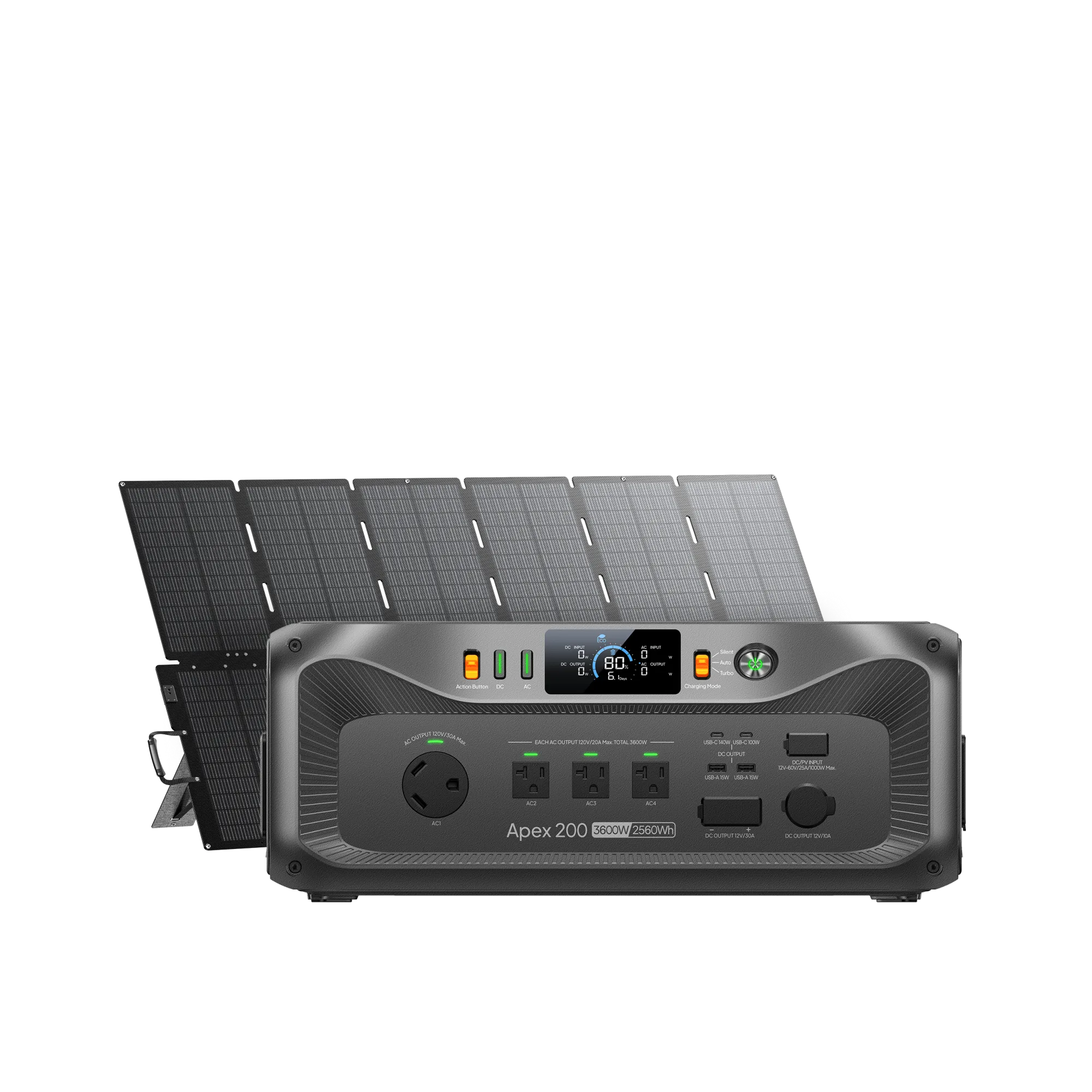
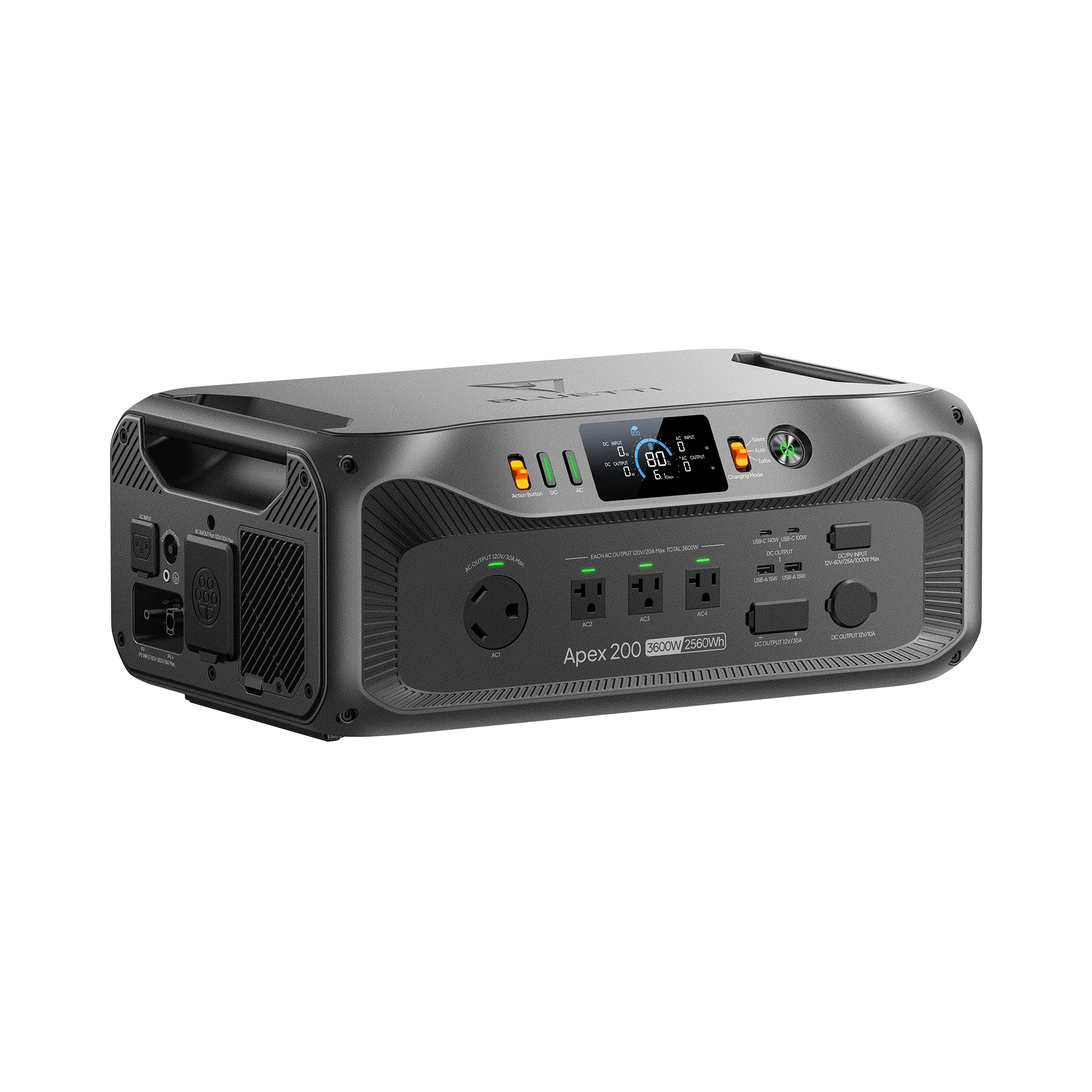
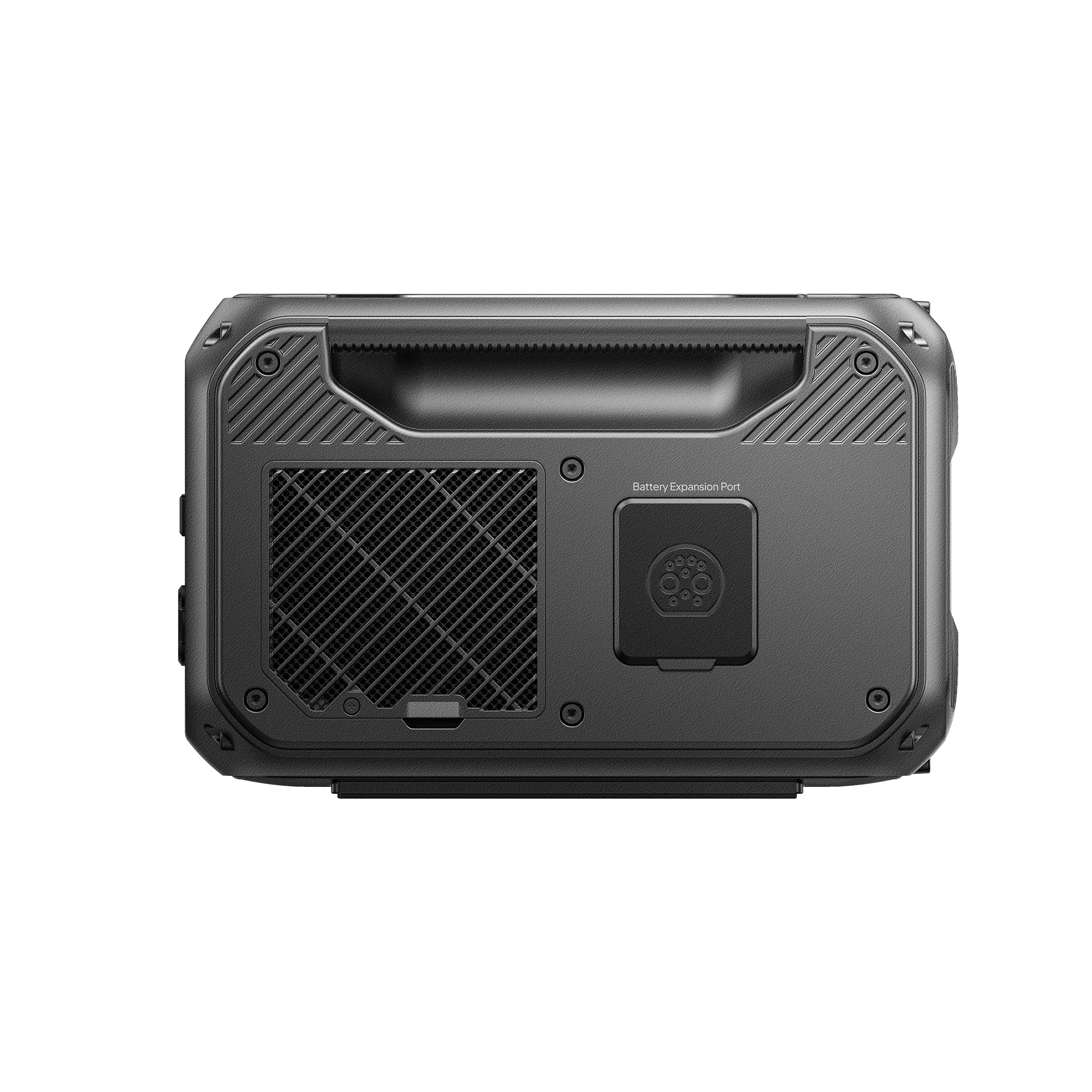
The Apex 200 sits between these philosophies. Its base specification lists 2,560Wh of capacity, up to 3,600W of output, and a 5,400W lifting power rating for starting demanding appliances. Despite its compact size, Bluetti states it can expand from 2.56kWh all the way up to 99.84kWh through additional battery modules, which makes it a smaller starting point than the Apex 300 but with a comparable long-term ceiling once modules are added.
Solar Input Differences: Dual-Range and Single-Range Charging Across the Range
Solar charging configurations differ noticeably between model lines. The Apex 200 supports up to 3,000W of dual-range solar input, split between a 2,000W high-voltage path and a 1,000W low-voltage path, letting it accept a wider variety of panel setups at once. That dual-range design is meant to accommodate different wiring configurations without forcing a single matched panel type.
The Apex 300, by contrast, is offered in bundles built around single-range solar panels, typically 350W or 500W units, and those can be combined, as seen in a configuration pairing two 350W panels for 700W of combined input. The Elite 100 V2 takes a different compact approach entirely, listing 1,000W of solar input through a built-in MPPT controller capable of a full charge in 70 minutes under suitable sun. These differences in solar architecture mean the practical charging speed of any home battery backup system depends heavily on which panels and input paths it was designed to accept.
UPS Switching Speed and Real-World Runtime: What the Specifications Mean for Continuity
Switchover speed matters most for anything sensitive to interruption, such as networking equipment or medical devices. The brand lists the Apex 200’s UPS backup response at 15 milliseconds or less, automatically shifting connected essentials to battery power when grid electricity drops. That kind of rating is what separates a genuine backup role from a unit that is only meant for manual, after-the-fact recharging.
Runtime, meanwhile, is a function of the capacity figures discussed earlier rather than a separate spec on its own. A larger capacity pool, whether reached through a single big battery or through stacked modules, simply stretches the time before a recharge is needed. Framing switchover speed and capacity together gives a clearer picture of how any of these home battery backup systems will behave during an actual outage rather than in a showroom demonstration.
Parallel Power and Load Management: Advanced Features for Multi-Device Setups
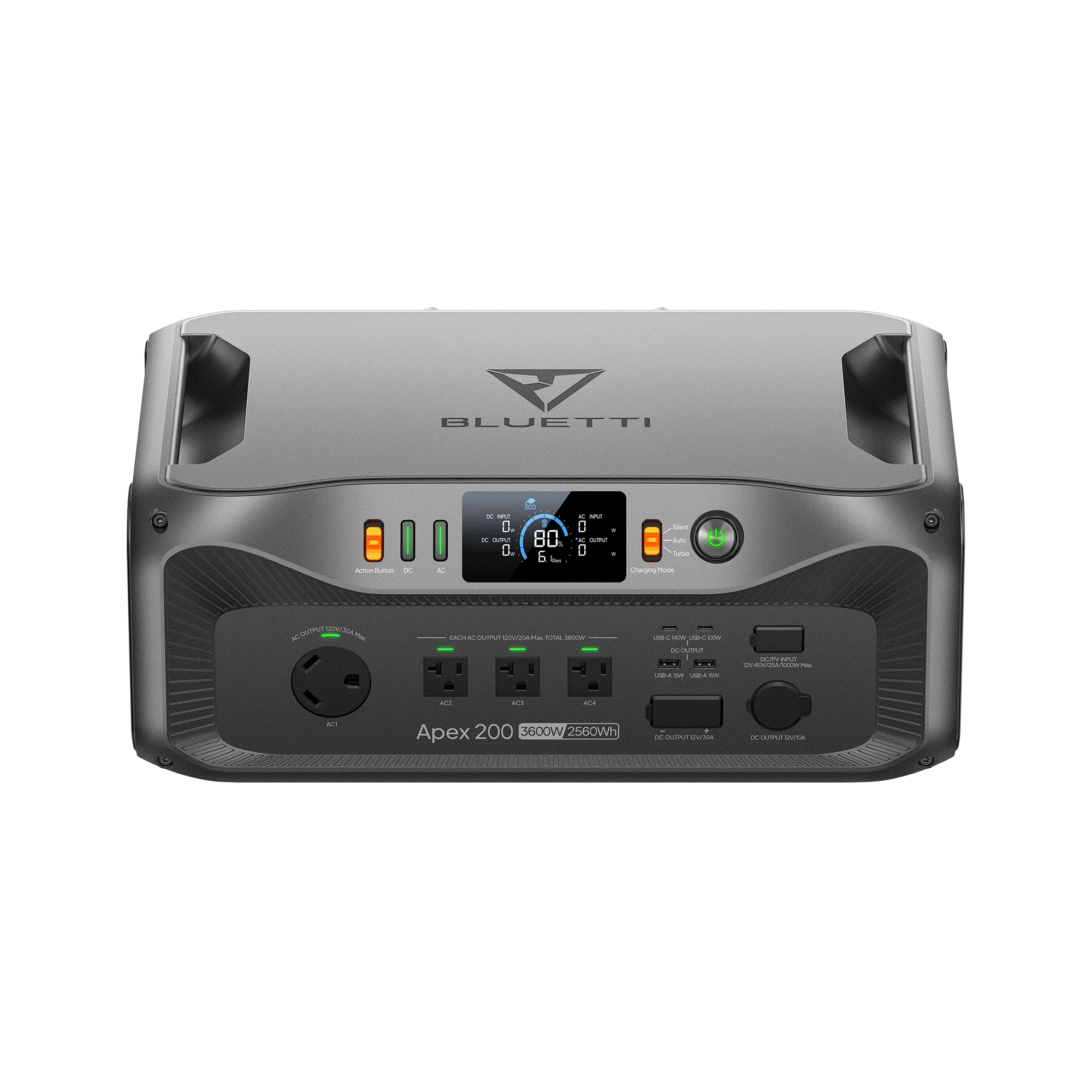
Beyond single-unit specifications, some setups call for combining multiple units into one coordinated system. The Apex 200 is rated for up to 6kW of parallel power on its own, a figure that sits below the combined output reached by linking two Apex 300 units as described earlier. These configurations are aimed at households running more than one major circuit off backup power at the same time.
Smart load control is also part of the picture for the Apex 200, which includes outlet management and essential-device prioritization through a companion app. For anyone assembling a larger home battery backup system out of multiple units, that kind of coordinated control becomes more relevant than it would be for a single standalone unit. Bluetti positions this layered approach, pairing hardware expansion with software-level prioritization, as the main difference between a basic power station and a true backup system.
Weighing these distinctions side by side gives a clearer sense of which configuration fits a given household’s demands.