


Finding the right balance between raw processing muscle and everyday reliability is the main challenge for anyone shopping for gaming and workstation desktops. Mwave stocks a wide catalogue spanning pre-built towers, barebone kits, and fully custom configurations aimed at rendering, design, and competitive play. This article walks through how the two categories differ, what It offers for each, and how buyers can decide between a ready-made system and a custom build.
Understanding Gaming PCs Versus Workstation Desktops
Gaming and workstation desktops share many of the same core parts, yet they are tuned for different jobs. A gaming tower leans on fast single-core performance and a strong graphics card to keep frame rates high during competitive play. A workstation, on the other hand, is built around sustained multi-core workloads, larger memory pools, and components rated for long rendering or simulation sessions.
Mwave organises its desktop range with this distinction in mind, listing separate categories for Mwave Gaming PCs and The brand Workstation PCs on its site. Home and business desktops sit alongside these two categories, which means shoppers can narrow a search by intended use rather than scrolling through a single undifferentiated list. That structure makes it easier to compare gaming and workstation desktops side by side before settling on a configuration.
Mwave Gaming PCs for Esports and Streaming
The Mwave Gaming PCs section groups towers built for esports titles, streaming setups, and general high-frame-rate play. These systems typically pair a desktop-class processor with a dedicated graphics card, since both parts carry the load during fast-paced matches. Cases in this range are drawn from the broader chassis catalogue, which includes ATX, Micro-ATX, Mini-ITX, and E-ATX options along with case mods and accessories.
Cooling is a practical concern for any gaming build that runs for hours at a time. Mwave lists both CPU air cooling and CPU water cooling, plus DIY water cooling parts, so a finished gaming system can be specified with whichever cooling method suits the chosen case and processor. Case fans and fan controllers round out the thermal side of a build.
Mwave Workstation PCs for Creative Professionals
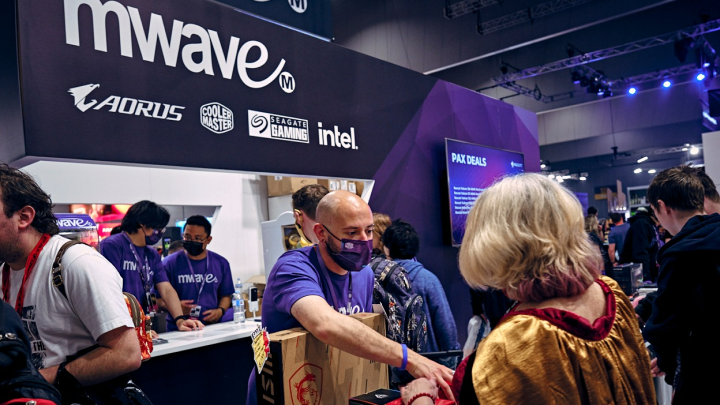
Workstation buyers tend to prioritise stability and sustained throughput over peak clock speed, and It’s Workstation PCs category reflects that. The site also lists Branded Workstations separately from its own configurations, giving professionals a choice between an off-the-shelf brand-name tower and a system assembled around specific workstation components. Servers and workstations appear as a dedicated storefront section alongside networking and storage gear.
Storage choices matter heavily for rendering and design work, and the catalogue reflects that with multiple drive categories. Solid state drives, 3.5-inch hard drives, NAS hard drives, and server or workstation HDDs are all listed as separate options rather than a single generic storage bucket. That level of separation allows a workstation build to pair a fast SSD for active projects with higher-capacity HDDs for archiving finished work.
Custom PC Configurator and Barebone Systems
For buyers who want to specify every part themselves, Mwave runs a Custom PC Configurator under its Desktop PCs menu, alongside dedicated pages for customising a dream PC and customising an Intel NUC. There is also a how-to guide on customising a PC, which suggests the configurator is meant to be approachable for people who have not built one before. Shoppers who prefer not to self-build can submit a Request Custom PC Quote or a Request Corporate PC Quote instead.
Barebone systems sit in their own category too, covering NUC, VivoMini, and Brix form factors. These compact kits suit buyers who want a smaller footprint than a full tower, whether for a secondary gaming station or a space-constrained workstation setup. Once a configuration is chosen, Mwave‘s Custom PC Assembly and Testing Service builds it from concept to a finished system, backed by a 2-year Return-to-Base warranty.
Graphics Cards and Processing Power in High-End Builds
Graphics cards are listed under AMD Radeon, NVIDIA GeForce, Intel Arc, and a separate Workstation Cards category, which keeps gaming-oriented GPUs apart from cards intended for professional rendering and compute tasks. Processors follow a similar split, with AMD Desktop CPU and Intel Desktop CPU listed as their own sections under the CPU menu. Motherboards are likewise divided into AMD and Intel categories, which helps keep a build’s platform choices consistent from CPU through to chipset.
Memory is organised by generation, with PC DDR3, DDR4, and DDR5 each listed separately, alongside a combined memory section covering PC, laptop, Mac, and server modules. This breadth matters for workstation builds in particular, since rendering and multitasking workloads tend to benefit from larger, faster memory pools. Together, the graphics card, processor, motherboard, and memory selections form the backbone of any serious gaming or workstation build.
- The processor determines how well a system handles both single-threaded gaming tasks and multi-threaded rendering workloads.
- The graphics card, chosen from categories such as AMD Radeon, NVIDIA GeForce, Intel Arc, or dedicated Workstation Cards, drives both frame rates and viewport performance.
- Cooling, available as CPU air cooling, CPU water cooling, or DIY water cooling parts, keeps components running within safe temperatures during long sessions.
- Memory capacity and generation, spanning DDR3 through DDR5, affect how smoothly a system handles large files and multiple open applications.
- Storage type, whether a solid state drive, a 3.5-inch hard drive, or a NAS-rated drive, shapes how quickly projects and game libraries load.
Choosing Between Pre-Built and Custom Desktop Solutions
Pre-built options from the The brand Gaming PCs and Mwave Workstation PCs categories suit buyers who want a configuration that has already been matched for a specific purpose. Branded Desktop PCs, including Apple Mac systems and Branded Workstations, offer another pre-built route for those who prefer a recognised manufacturer. These paths generally mean less decision-making for the buyer, since the component list has already been finalised.
Custom builds, by contrast, suit buyers with specific requirements around storage layout, cooling, or graphics card type. The Custom PC Configurator, the dream PC customiser, and the Intel NUC customiser all give a way to adjust individual parts rather than accept a fixed list. For those who would rather describe requirements than pick every part, the Request Custom PC Quote and Request Corporate PC Quote forms offer a middle path between a fixed pre-built and a fully self-specified system.
Deciding between the two ultimately comes down to how specific the intended use case is. A general gaming or office setup may be well served by a pre-built tower, while a rendering-heavy or simulation-focused workload often calls for the finer control a custom configuration provides. Either way, the Custom PC Assembly and Testing Service remains available to put a chosen set of parts together and test it before it ships.
Closing Thought
Gaming and workstation desktops will keep evolving alongside new processors, graphics cards, and memory standards, but the underlying choice stays the same. Buyers weigh a ready-made configuration against the flexibility of building to a specific brief.